In Ontario, faucet repair usually means replacing a worn cartridge or seal set, clearing out scale, or installing a new faucet when the old one is done. Ontario Municipal Utilities Company supplies the water, and its hardness depends on the mix of groundwater and imported water reaching your tap. Call the number on this page to be connected with a local plumber in Ontario.
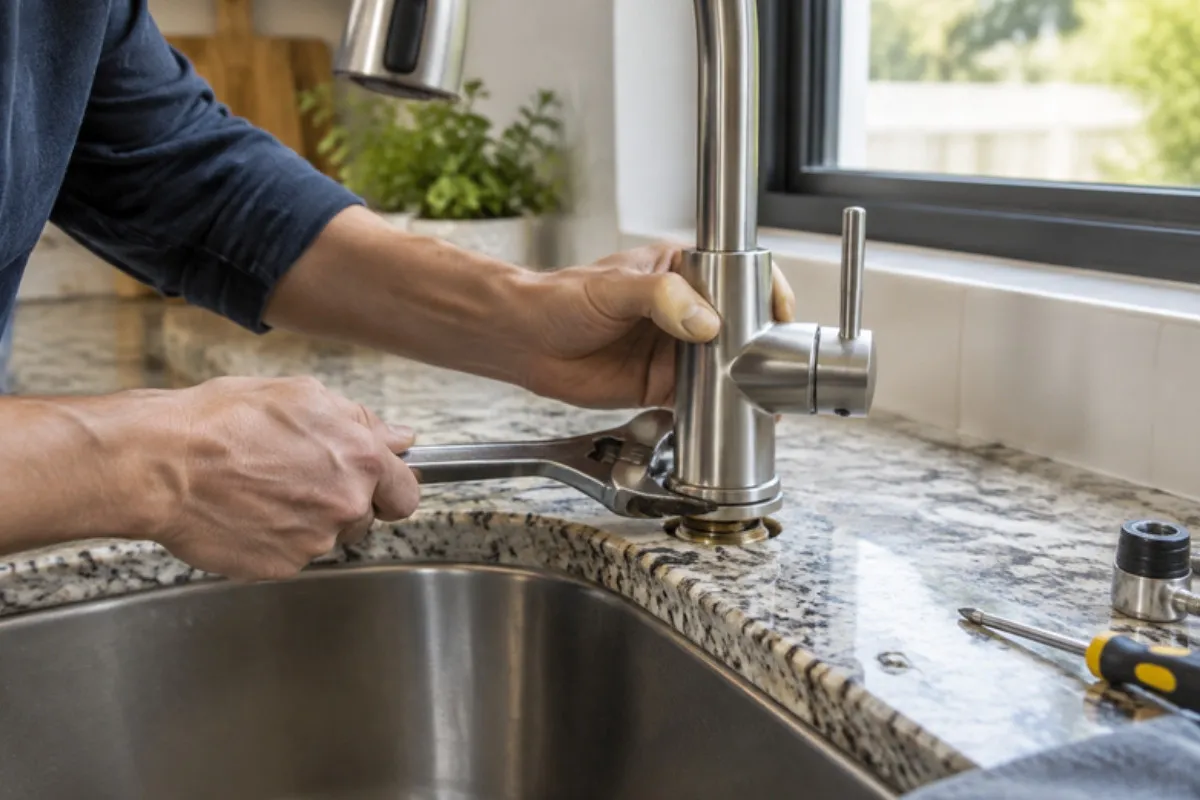
Why do Ontario faucets scale up and start dripping?
Ontario Municipal Utilities Company (OMUC) serves the whole city, mostly with Chino Basin groundwater from City wells. It adds purchased groundwater from the Chino Basin Desalter Authority and Jurupa Community Services District wells, plus imported State Water Project water treated at the Water Facilities Authority plant. Its 2025 report lists hardness averaging 124 mg/L in City groundwater (range 82 to 150), 91 mg/L in imported water, and 137 to 177 mg/L in the purchased groundwater. Whatever the blend on a given day, those minerals settle on aerator screens and inside cartridges, where they roughen the sealing surfaces until a faucet drips or a handle turns stiffly.
The report also lists a total chlorine residual that includes chloramines. Chloramine can slowly harden some ordinary rubber, so seals rated for it are worth asking for during a rebuild.
Is the faucet in my older Ontario home worth rebuilding?
Often it is. Ontario began in 1881 as the Chaffey brothers' planned citrus colony, and the city's median home was built in 1980, so there is a wide spread: older houses near Downtown with two-handle compression faucets, mid-century and 1980s tracts with single-lever cartridges, and new construction in Ontario Ranch. A solid brass faucet with available parts usually rebuilds well with new washers, seats or a cartridge. A plumber will suggest replacement when parts are discontinued, the body is corroded or cracked, or the faucet keeps failing after earlier repairs. Stops and supply hoses of the same age are often worth changing during the visit.
Who do I call if the leak is not at the faucet?
If water is showing at the meter or the street, call OMUC Utilities Customer Service at (909) 395-2050. OMUC says its lead service line inventory confirmed there are no lead service lines in its system. Inside the property, the plumbing and fixtures are the owner's, and a plumber can trace leaks between the meter and the house. If faucet work turns into new piping, the City of Ontario Building Department handles permits, with applications submitted electronically through its Citizen Portal; the plumber can tell you whether one is needed.
A note on backflow devices
Some Ontario properties have a backflow assembly near the meter or on an irrigation line. OMUC's Water Quality Programs Division decides case by case which properties need one, and each must be tested at least once a year by a City-approved tester, with results filed online. A dripping backflow assembly is a job for a certified tester, not a faucet repair, so mention it if that is where the water is coming from.
Faucet Repair questions in Ontario
Does the hard water here shorten the life of faucet parts?
Can chloramine in the water supply affect faucet seals?
Should I be concerned about lead from older faucets or pipes?
When is a new faucet a better choice than a rebuild?
More plumbing services in Ontario
Faucet Repair nearby
Helpful guides
Sources
Last updated: