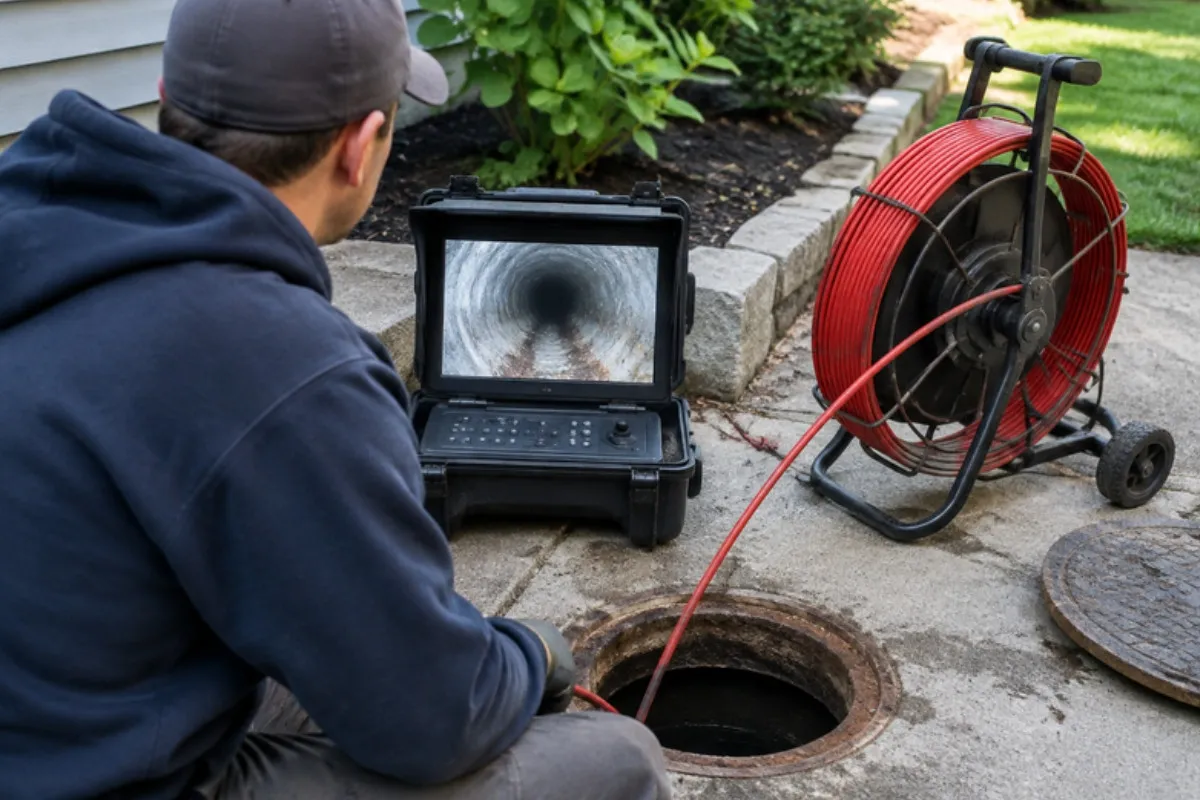
In San Bernardino, the Municipal Water Department owns and maintains the sewer main in the street, while the lateral running from your house to that main is the property owner's to maintain. A sewer camera inspection sends a waterproof lens through that lateral so you can see roots, cracked joints, sags or buildup before anyone breaks ground. Call the number on this page to be connected with a local plumber in San Bernardino.
Signs the main line needs a camera
- The tub or shower fills with dirty water when a toilet is flushed
- Drains all over the house slow down together rather than one at a time
- Toilets gurgle or bubble while the washer drains
- A sewage smell near the cleanout cap or along the side of the house
- The same main line stoppage returns a few weeks or months after being cleared
When only one fixture is sluggish, the trouble is usually in that fixture's trap or branch. Problems that show up across the house point to the single pipe everything shares on its way to the street, and that is the line a camera is made for.
San Bernardino conditions
The San Bernardino Municipal Water Department runs wastewater collection and treatment for the city and also treats sewage for Loma Linda and Colton. Its FAQ is plain about the split: the city side owns the main in the street, and the property owner maintains the sewer lateral. Properties within 200 feet of a sewer main must connect to the system, so most homes in town drain to an SBMWD main through a private lateral.
Housing age makes camera work common here. In ZIP 92404, city-data.com counts about 72% of houses (14,174 of 19,677) as built in 1979 or earlier. Laterals that old, in neighborhoods from the West Side to the streets around downtown, can be clay or cast iron, and those materials tend to crack at joints, shift out of line and let roots in. Slab foundations are the norm, so the first section of drain often runs under the floor before it heads out to the yard. Newer homes up in Verdemont are more likely to have plastic pipe, which resists roots but can still sag where trench soil settled.
What affects the cost
- Getting in. A reachable cleanout is quickest. Without one, the camera may go in through a pulled toilet or a roof vent.
- Standing water. A full line has to be opened first, since the lens cannot see through wastewater.
- Distance and bends. A long run to the main or several turns takes more cable and time.
- Locating and records. Marking the defect on the ground and saving the footage add a little time and make any repair quote easier to check.
What happens when you call
The number on this page connects you with an independent local plumber who works in San Bernardino. Be ready to say which drains are affected, where the cleanout is if you know, and when the line was last cleared. If neighbors are backing up too, the main may be at fault, and SBMWD takes water and sewer emergencies at 909-384-5141, with an answering service after hours. If the footage leads to a repair, the City of San Bernardino Building & Safety Division handles plumbing permits at its counter at 201 North E Street.
Sewer Camera Inspection questions in San Bernardino
Which part of the sewer line is the homeowner's responsibility?
Who should I call when sewage backs up after hours?
Can the footage show what kind of pipe I have?
Can the plumber find the exact spot of the damage from above ground?
More plumbing services in San Bernardino
Sewer Camera Inspection nearby
Sources
Last updated: